
Build Before the Storm

When you live on the Georgia coast, you learn an important lesson. You don't prepare for a storm after it's on the radar. You prepare long before the clouds gather. Over the years, I've discovered that the same is true for organizations.
Whether a federal agency, a Fortune 500 company, a nonprofit, or a small business, the organizations that navigate change most successfully aren't necessarily the largest or the best funded. They're the ones who prepared before they had to.
A storm doesn't always arrive with wind and rain. Sometimes it arrives as the unexpected retirement of a longtime executive director. A cyberattack. The loss of a major donor or customer. A board transition. A technology failure. Or simply the departure of the one person who "knows how everything works." Those moments reveal something every leader eventually learns: Resilience isn't built during a crisis. It's built long before one ever arrives.
After recently moving to the Golden Isles, one of the things that has impressed me most is the incredible number of organizations that make this community stronger. Our churches, nonprofits, schools, healthcare organizations, family businesses, and civic groups are powered by passionate people who care deeply about their missions. Ironically, that's also where many organizations become vulnerable.
When people care deeply, they naturally step in and solve problems. Over time, knowledge begins to collect in one person's head. Passwords are remembered instead of documented. Vendor relationships exist in someone's personal email. Processes become "the way we've always done it." Everything works—until one day it doesn't.
The good news is that building resilience doesn't require a massive budget or complicated technology. It starts with three simple habits:
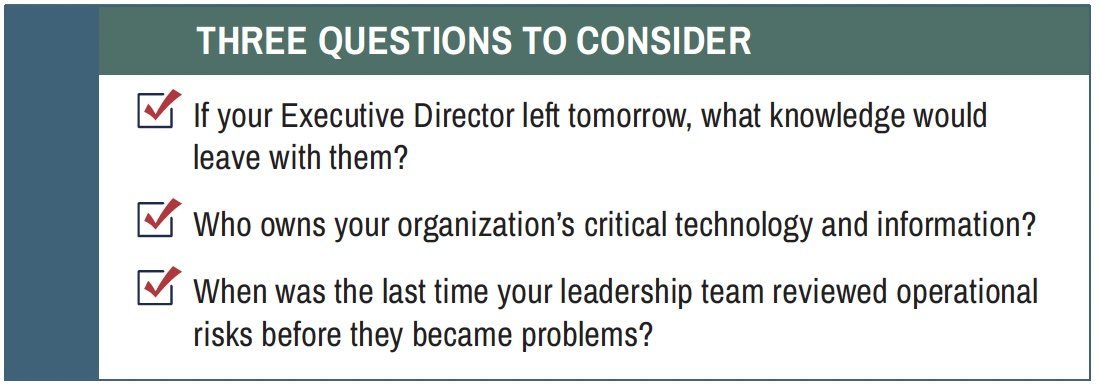
1. Document what matters. If your organization depends on information that only one person knows, you've created unnecessary risk.
2. Share responsibility. Every critical system, relationship, and decision should have more than one person who understands it. Strong organizations build teams, not dependencies.
3. Schedule time to review before you’re required to react. Once a year, ask a few simple questions: What has changed? Where are we vulnerable? What would happen if a key leader couldn't be here tomorrow? Those conversations often uncover opportunities long before they become problems.
Over the coming months, I'll be sharing practical lessons I've learned from more than two decades of helping organizations navigate change, improve operations, and prepare for what's next. Some lessons come from global boardrooms. Others come from local nonprofits. While organizations may differ in size and mission, many of their leadership challenges are remarkably similar.
As we continue this conversation together, I'll leave you with one question:
If tomorrow brought an unexpected storm, would your organization be ready—not just to survive, but to move forward with confidence?
What topics would you like to see covered in a future column? Share your thoughts at TraceyGrace.com and connect at LinkedIn.com/in/TheTraceyGrace.